
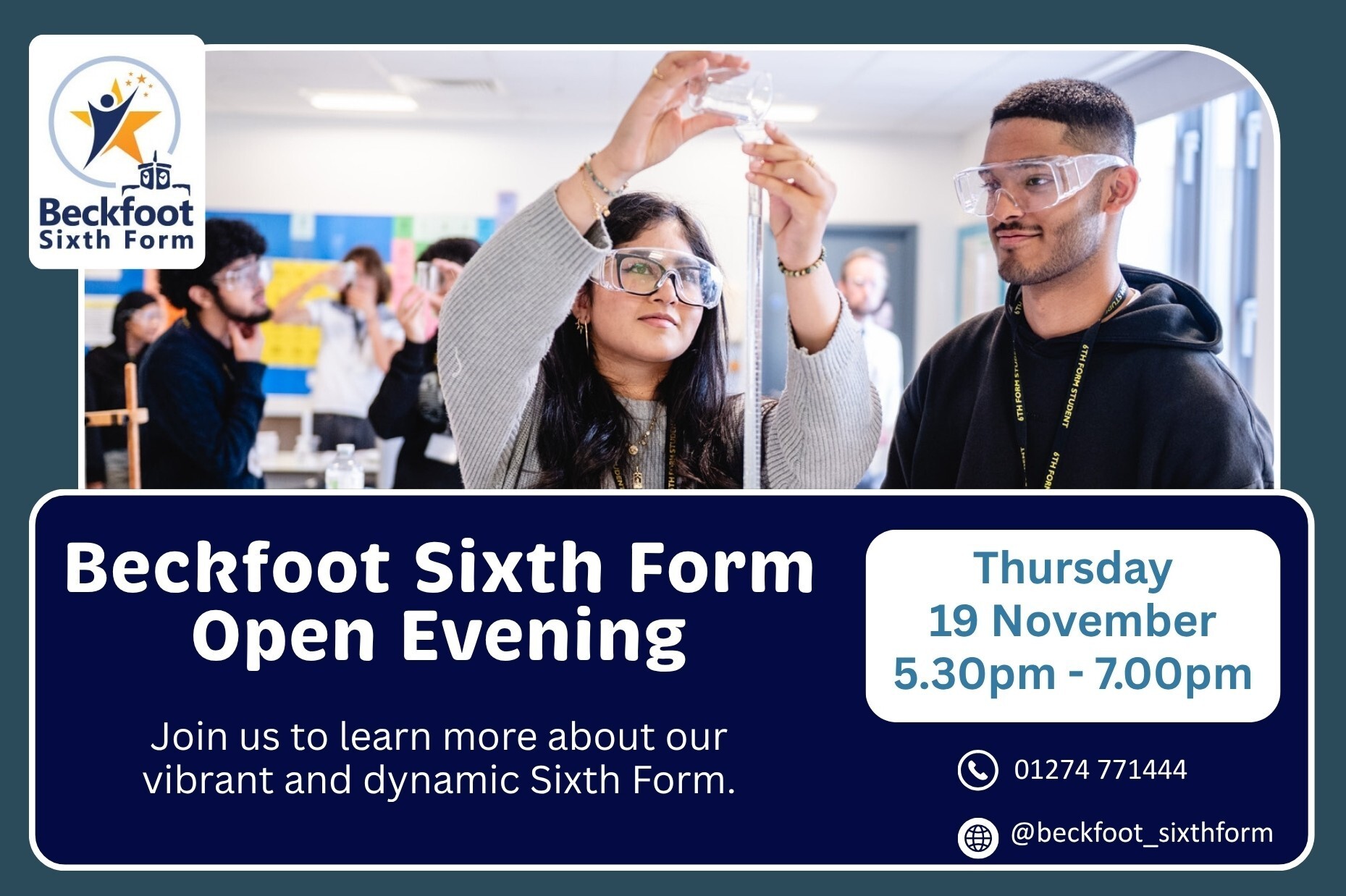
Sixth Form Open Evening - Thursday 19 November 2026
Our team will be here to support Year 8 students through any problems they have.
Should you ever have concerns or queries, please contact the school on 01274 771444.
Year 8 Enrichment – We are committed to providing as many enrichment activities as possible for our students.
Trips and experiences run throughout the year and can range from residential trips, subject-specific trips and reward trips.
Enrichment Week is the final week of school before Summer, where students will have the opportunity to take part in an activity of their choice.
SSAT Awards, the Student Leadership Accreditation is an innovative way of recognising students’ leadership skills and the impact that they have in the classroom, across the school, and in the wider community.
| Subject | Cycle 1 | Cycle 2 | Cycle 3 |
|---|---|---|---|
| Art | Semi-abstract art – Annibot (animal robot) isometric design Architectural styles – Ceramic fireplace (candle holder) design and sculpture | Architectural styles – sculpture embellishment Cubist portrait – lino production print | Abstraction – mixed media drawing |
| Computer Science | Data Representation: Students will explore how data is stored and represented digitally. Students will understand how text, images, and sound are converted into binary form. | Small basic programming: Students will learn fundamental programming concepts using Small Basic, developing problem-solving and logical thinking skills. Students will safely create programs that model real-world problems and strengthen computational thinking. | Hardware, software, system security and logic gates: Students will learn about computer components, storage devices, and logic gates. Students will also explore system security and safe computing practices, understanding how hardware, software, and cybersecurity work together. |
| Design Technology | Product Design/Engineering – Container Students are introduced to more advanced product design in view of making an end product of a container, students will work with a range of marking out and practical equipment to produce and end outcomes. Students will learn about logo design, types of plastic and SMSC issues in product design. | Food – Multicultural Meals Students will be introduced to more advanced food technology in view of making a final dish of their choosing. Students will work with a range of equipment and oven features as they learn about different food cultures and environmental issues associated with food. | Textiles – Graffiti Students will be introduced to more advanced textiles through creating a range of samples in view of making an end product of a selfie art inspired cushion. Students will work with a range of marking out and practical equipment to produce an end outcome. |
| English | Travel Writing: Students will develop their understanding of the conventions of non-fictional travel writing and use their knowledge to create their own written piece. | War poetry: Students will learn about war poetry, exploring why soldiers chose poetry to express their experiences and feelings. | Ghosts and ghouls: Students will be introduced to Gothic conventions and be exposed to a range of Gothic texts. |
| Geography | Volcanoes: Students will gain an introduction to plate tectonics and natural hazards, as they focus on the cause and impacts of volcanic eruptions. They will be able to identify constructive and destructive plate boundaries and describe how movement can cause volcanic eruptions. | Urban geography: Students will understand the concepts of urbanisation and growth in UK cities and compare opportunities and challenges of urbanisation in HIC’s and LIC’s. Students will also look at sustainable urban living. | Development in the Horn of Africa: Introduction to the concept of development, development gaps and inequality, as students learn about concepts of poverty and the promotion of economic development. They will be able to explain the causes of inequality in development and suggest strategies to reduce inequalities. |
| History | How revolutionary was the French revolution? Students will be able to explain concepts like monarchy and democracy and explain why the English Civil War and the French Revolution happened and assess how much impact they have on the way in which their countries were ruled | How did the British Empire change the world? Students will be able to explain key concepts such as imperialism and independence as they explain how Britain formed it’s empire and assess its impact on different places | Why was WW1 called the ‘war to end all wars’? Students will explain why both world wars started and explain the significance of key turning points in each war and their impacts on consequences |
| PSHCE | Living in the wider world: careers – Career choices, study skills, pathways to your future, types of work, challenging stereotypes, factors affecting financial decisions and managing emotions and risk – followed by an end of term assessment on living in the wider world. | Health and wellbeing: Mental health – Defining stigma, nutrition and exercise, positive relationships, bereavement and coping strategies and the impact of the online world, know your selfie – followed by an end of term assessment on mental health and wellbeing. | Relationships – Oversharing online, cybercrime, online risks to consent, discrimination and prejudice, cyberbullying, upholding your right and those of others online – followed by an end of term assessment on relationships. |
| Maths | Number – negatives, rounding | Number – BIDMAS and decimals, fractions, percentages | Algebra – linear graphs |
| Performing Arts | Film Trailer: Students will use their stagecraft and performance skills to perform a film trailer – they will devise their own trailer to advertise to the audience, using techniques such as physical theatre, direct address, voice over, montage and slow motion. | Melodrama and pantomime: Students will be introduced to the conventions and techniques used in melodrama and pantomime using techniques such as direct address, asides, mime and slapstick comedy. | Romeo and Juliet: Student will use their stagecraft and performance skills to stage key scenes from Romeo and Juliet including the prologue, a soliloquy and a fight scene, as they explore techniques to communicate mood and atmosphere through different styles. |
| German | Oracy: Revision of adjectives and opinions to describe a photo and give opinions on it to allow students to speak with increased confidence and better pronunciation. | Media and Technology: Pupils will express views and opinions about books, TV shows, films and the internet. | School trips: Students will learn key vocabulary to do with the house and home. |
| Music | Music and advertising: Students will compose jingles and explore the role of music in branding, understanding underscore and voiceovers Blues: Students will study the 12-bar blues, improvisation, and syncopation while learning about its historical links to slavery | Pop music: Students will explore catchy hooks, baselines, and music technology, arranging their own pop songs Film music: Students will learn about leitmotifs, underscoring, and composing music for film scenes | Latin American Music: Students will perform tango and samba rhythms, developing complex rhythmic and harmonic skills Hip hop: Students will learn about the cultural impact of hip hop music as they write and perform rap lyrics, exploring beat-making and music technology |
| French | Oracy: Revision of adjectives and opinions to describe a photo and give opinions on it. Students revise questions words and take part in role-play situations. | Paris: Students are able to build upon their cultural capital through the study of Paris. | Where you live: Students will learn key vocabulary to do with the house and home |
| PE | Learners will consolidate core skills and basic tactical awareness in isolated practices, conditioned/larger full sided games, while consolidating knowledge of basic rules and leadership skills in cricket and rounders. Learners will consolidate core skills and develop advanced tactical awareness in a range of isolated practices, conditioned and larger/full sided games while developing knowledge of advanced rules and leadership skills in badminton, football, basketball, netball and rugby. Learners will consolidate core skills and develop advanced skills on the floor and larger apparatus in gymnastics, they will develop their choreographic devices and leadership skills in gymnastics. | Learners will consolidate core skills and develop advanced tactical awareness in a range of isolated practices, conditioned and larger/full sided games while developing knowledge of advanced rules and leadership skills in badminton, football, basketball, netball and rugby. Learners will consolidate core skills and develop advanced skills on the floor and larger apparatus in gymnastics, they will develop their choreographic devices and leadership skills in gymnastics. | Athletics – consolidation of core skills and development of advanced skills at faster pace/using age-appropriate equipment and developing further technical and tactical knowledge. |
| RE | Evil and suffering: Students will explore the question if whether evil means God cannot exist Atheism and Humanism: Students will explore atheist arguments and humanist values to learn how people can place meaning without religion | Science and religion: Students will learn that science and religious beliefs about truth, creation and evolution can be conflicting Hinduism: Students will know key Hindu beliefs about the nature of God and how this is manifested in the form of different Gods and Goddesses | Sikhism: Students will know key Sikh beliefs about the nature of God, pilgrimage and equality, students will know about the lives of two gurus and how they influence Sikhs today Rights and religion: Students will know that humans and animals have rights and what the main six religions trach about this |
| Science | Chemistry: Periodic table and materials | Chemistry: Earth and atmosphere | Biology: Inheritance |