
Sixth Form Open Evening - Thursday 19 November 2026
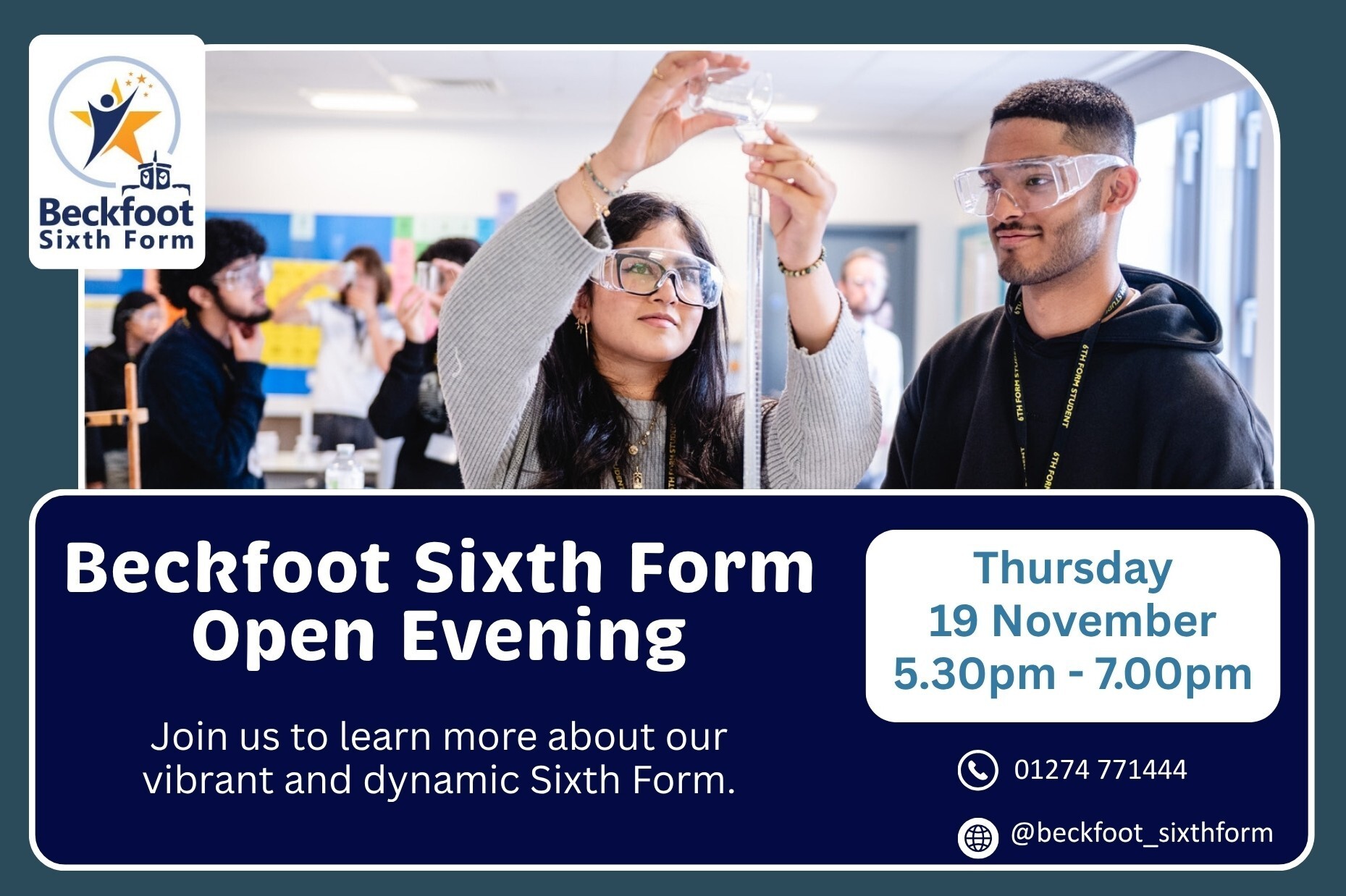
As you embark on your final year at Beckfoot and you GCSE exams, we want to ensure you have the skills, knowledge and confidence to succeed.
Students will ensure they are fully prepared for the exams as we support them with revision, and ensure they’re equipped with strategies to deal with what can often be a stressful period in their lives.
We will also ensure students are prepared to begin the process of considering their next destinations – whether they choose to remain at our Sixth Form, go to college, or enter an apprenticeship or employment.
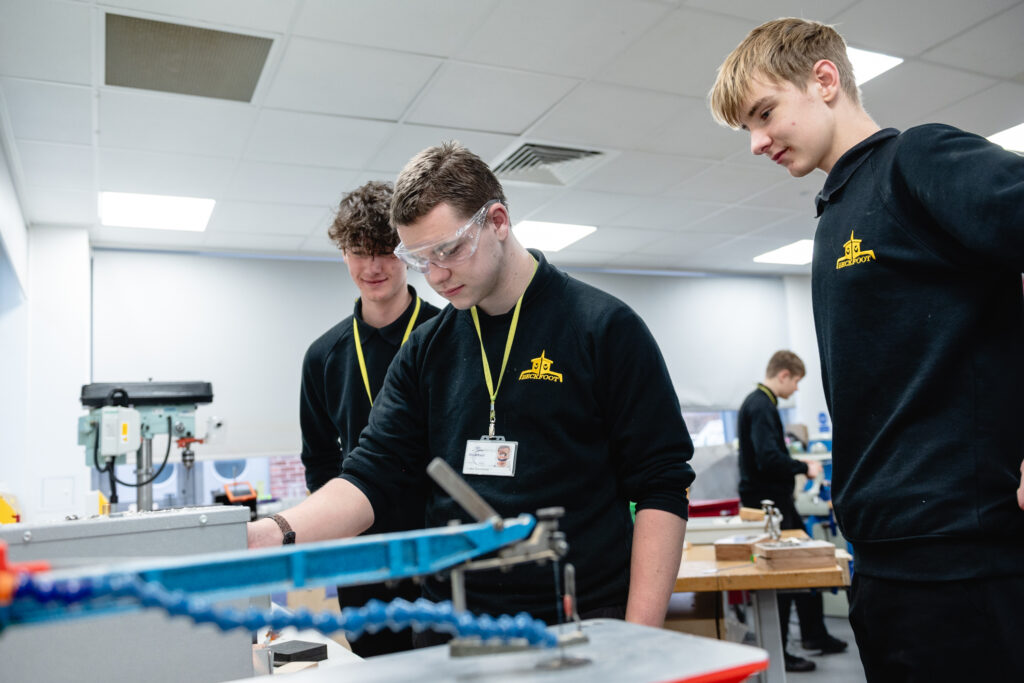
Our team will be here to support Year 11 students through their GCSE exams, and prepare them for life when they leave school.
Should you ever have concerns or queries, please contact the school on 01274 771444.
Year 11 Enrichment – We are committed to providing as many enrichment activities as possible for our students.
Trips and enrichment experiences run throughout the year and can range from residential trips, subject-specific trips and reward trips.
| Subject | Cycle 1 | Cycle 2 | Cycle 3 |
|---|---|---|---|
| Art | Fine art – Mechanical objects: Further developments – sculpture embellishments, mixed media experiments and surreal (morphing) animal Graphics – Pop culture convention: Experimentation Photography – Structures: Experimental drawings | Fine art – Mechanical objects: Further developments – ceramic portrait, artificial heart, synthetic portrait or abstract outcome Graphics – Pop culture convention: 3D pop-up box, final outcomes Photography – Structures: Sculpture, mixed media, experimentation, final design ideas and outcomes | Fine art – Externally set task: Mind map, observations, artist study, develop, experiment, refine and supervised time Graphics – Externally set task: Artist research, Artist studies, Related Research, Typography, Logo Developments, Experimentation, Final Design Ideas Photography – Externally set task: Mind-Map, Research, Analysis, Drawing, Studies, Experimental Photography and Post-Production |
| Computer Science | Unit 5 – Computer networks: Students will learn about computer networks, their types, benefits, risks, and the differences between wired and wireless networks. They will also focus on safe network practices and protecting data in connected environments. | Unit 7 – Relational Databases and Structured Query Language (SQL): Students will learn about relational databases, their structure and how to write SQL queries. They will apply these skills to manage and interrogate data safely and responsibly. | Preparation for GCSE Exams: Students will consolidate all content covered over two years and practise answering GCSE-style questions. They will apply knowledge and practical skills safely and effectively, preparing for assessments and real-world applications. |
| English | Literature paper 2 – An Inspector Calls: Students will learn to answer a character or theme based essay on the text. | Literature paper 1 – Romeo and Juliet: Students will be able to answer questions on all the characters and all the themes within the novel. | Power and Conflict poetry: Students can write a full comparative essay on any named poem and one other from the anthology. |
| Geography | Physical landscapes in the UK: river landscapes – distinctive fluvial landforms and management strategies for flooding. | Physical landscapes in the UK: Coastal landscapes – looking at distinctive coastal landforms and understanding that they are the result of rock type, structure and physical processes. Looking at strategies to protect coastlines. | Resource management: students will understand the changing demand and provision of resources in the UK, looking at ways to increase food supply, water supply and energy supply. |
| GCSE Health and Social Care | Current public health issues Factors influencing health | Plan and create a campaign Deliver and evaluate the campaign | Protecting service users Retrieval practice |
| History | Part 1 – Elizabeth’s court and parliament: Students will continue their study of how Elizabeth ruled the country and learn to complete questions 1-3 of a full Elizabeth paper. | Part 3 – Troubles at home and abroad: Students will learn about reactions to Elizabeth’s religious policy, the problem of Mary Queen of Scots and the conflict between England and Spain. | Thematic study: theme (Medicine/Power) has changed over time from the Medieval period to the present day. They will explore how key factors have impacted the lives of people in Britain across the time four time periods studied. |
| PSHCE | Living in the world: Careers – GCSE ready, Unifrog refresher, online presence, CV writing, keeping safe, tax and public spending, influence of media – end of term assessment on living in the wider world. | Health and wellbeing: Mental health – The importance of mental health – Balance, substance misuse, stress management, anxiety and the strategies to cope, gaming and gambling – followed by an end of term assessment on mental health and wellbeing. | Relationships – Online data, carrying weapons, year 7-11 recap, human rights, controlling and coercive behaviours, online data rules – followed by an end of term assessment on relationships. |
| Business | Growing the business Making marketing decisions | Making operational decisions Making financial decisions Making human resources decisions | Revision of all learning from the start of the course |
| Maths | Foundation Higher | Foundation Higher | Foundation Higher |
| German | School and education: Talking about school – subjects, teachers, uniform, rules. | Media, technology and celebrity culture: Students will discuss the pros and cons of the internet, social media and mobiles. Give opinions about famous people and how they influence young people. | Exam period and revision covering all four key skills: Students will have ample opportunity to prepare for the listening, reading and writing exam. |
| Music | Revision recap and composition development: Students will focus on listening and appraising skills, essay writing practice while they begin to develop their first composition and prepare for their first performance Set work – Africa by Toto: Students will analyse this pop song in depth, using DR SMITH to explore its key musical features. They complete listening and essay-style questions to test their understanding | Set work – Badinerie by J.S. Bach: Students will study Baroque music, focusing on melody, ornamentation and harmonic development- this unit includes listening and appraising exercises Composition 2 (set brief): Students complete their second composition based on a brief provided by the exam board, ensuring it meets all required criteria | Performance preparation: Students will refine both solo and ensemble performances, recording final versions for assessment Final revision: Students will review all set works, music theory and listening skills in preparation for their exam |
| Engineering | Students will work on a series of 12 different mini projects, each project will focus on the core principles of engineering – Engineering materials, engineering processes, and engineering requirements. Students will also work on their use of CAD software and fusion. | Year 11 NEA – externally set by the exam board each academic year. | Globalisation of engineering – Manufacture planning, MRP and JIT lean manufacture social, moral, ethical and sustainability issues associated with engineering. |
| French | Education – Oracy focus: Expose students to all GCSE speaking activities role play, photo card, reading aloud, and general conversation – all speaking is linked to education. | Media, technology and celebrity: Students will improve all 4 skills and be able to discuss their online life, fitness, viewing habits and celebrities they admire. | Exam Period and Revision covering all four key skills: Students will have ample opportunity to prepare for their Listening, Reading and Writing Exams. |
| PE | Core: GCSE: | Core: GCSE: | Core: GCSE: |
| RE | Christian practices: Students should study the beliefs, teachings and practices of Christianity specified below and their basis in Christian sources of wisdom and authority | Religion and life: Students should study religious teachings and religious teachings and religious, philosophical and ethical arguments, relating to abortion, euthanasia and animal experimentation | Muslim practices: Students should study the beliefs, teachings and practices of Islam and their basis in Islamic sources of wisdom and authority |
| Science | Ecology | Magnetism | Organic chemistry |
| Hospitality and Catering | High level skill preparation techniques, performance review, dish justification Practical work – This will be where the students design dishes to suit a brief, 2 main dishes and 2 side dishes NEA planning and written work, students are given the real exam board scenario and start to work towards making notes for each recorded class session | Food safety in hospitality – pathogens, preventions, allergies, intolerances Practical work – sweet and savoury dishes of choice to reflect a complex skill, specialist cooks, dough, pastry, chicken, vegetable dishes | Revision booklets and exam papers Practical work – occasional celebration cooks |
| Performing Arts | Component 1 Performance NEA: Students perform their final component 1 performance in response to a stimulus and in a style of their choice. | An Inspector Calls (Act 1 & 2) Context, lighting and set design: Students build on their knowledge of An Inspector Calls, interpreting the text from the perspective of a Director, Actor and Designer, while developing their essay writing technique. | An Inspector Calls (Act 3) Sound and Costume Design: Students build on their knowledge of An Inspector Calls, interpreting the text from the perspective of a Director, Actor and Designer, while developing their essay writing technique. COMPENENT 3 EXAM |